Showing posts with label opening title sequence. Show all posts
Showing posts with label opening title sequence. Show all posts
Monday, 7 April 2014

Sunday, 15 December 2013
First edit of our OTS
In our first cut the footage doesn't flow as one would expect a film to, our continuity isn't perfect however it isn't so bad for our first try. This task allowed me to consider the 180 degree rule and basic errors in continuity ( I even spot it a lot on TV!) This will benefit my Final OTS task since I will be looking for these errors as we film and hopefully avoid most errors that may occur. The sound on this edit is atrocious because we filmed it in a noisy area, I will listen to the noise on camera before filming in any particular location.

Planning our continuity task
This continuity task was set to test our knowledge and understanding of the 180 degree rule,match on action, shot/reverse shot.
We used Facebook chat to communicate throughout the group. Here Morrighan has used a voice over to explain what is going on while the rest of the group were planning scripting and narrative ideas. I will try to use this technique to demonstrate my work in the near future.
Saturday, 21 September 2013
Analysis of Scott Pilgrim Vs. the world
I have looked at the opening title sequence and the end credits of the 1995 film se7en; this is my analysis from what I have read and watched about the opening title sequence. I have included the relevant links below:
What conventions of an opening title sequence are being met in the opening title sequence of Scott Pilgrim vs. the World?
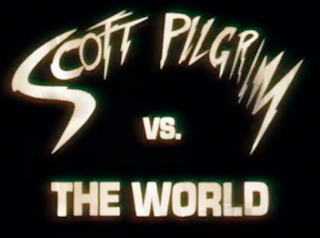
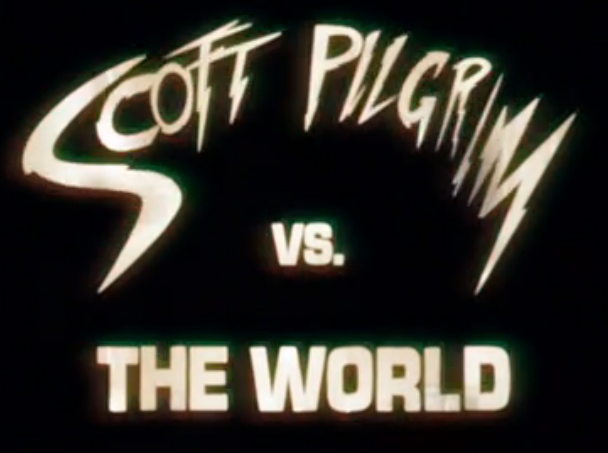
Many conventions of an opening title sequence are included in this title sequence such as; using an opening scene, using sound effects to enhance the sequence,crediting the film company (See image 1),crediting the producer and production company (See images 2),title of the film (See image 3), credits to the main actresses and actors (See image 4), music (See image 5), credits to director and other key crew members (See image 6), use of special effects and significant props (see image 7), and towards the beginning a small amount of narration over text (See image 8) Another convention at the very beginning of the clip that is common is the logo of the film company (See image 9)




What conventions of an opening title sequence are being challenged?


Overall in comparison to Se7en this opening title sequence breaks the boundaries in a similar way however the style in which it has been done is entirely different especially between genre and special effects. In se7en it was credited to have been given "analog warmth and randomness which may have otherwise been cheapened by digital effects." Where as in Scott Pilgrim Vs. the World there was a lot of perfectionism and they even made a mood-film before creating the full sequence (which can be found on the top link) "The shot took about 20 takes to nail and was shot on the second day of filming, a good ambitious set up to start with." this shows how much effort was put into every aspect of the title sequence especially as if you read on they explain that they had created the room to fit the 50ft technocrane in to film the giant room out on the living room scene.
Many conventions of an opening title sequence are included in this title sequence such as; using an opening scene, using sound effects to enhance the sequence,crediting the film company (See image 1),crediting the producer and production company (See images 2),title of the film (See image 3), credits to the main actresses and actors (See image 4), music (See image 5), credits to director and other key crew members (See image 6), use of special effects and significant props (see image 7), and towards the beginning a small amount of narration over text (See image 8) Another convention at the very beginning of the clip that is common is the logo of the film company (See image 9)
(Image 1)
(Image 2.1)

(Image 2.2)
(Image 3)
(Image 4)

(Image 5)

(Image 6)

(Image 7)

(Image 8)

(Image 9)

What conventions of an opening title sequence are being challenged?
This opening title sequence has a considerable amount of conventions that are challenged; we find that the logo crediting the film company has been edited to look old a pixelated accompanied by 8-bit music to give it an edgy game-like feel portraying surrealism (See image 9), also there is an unusual introduction/briefing on the main characters (See image 10), uncommonly there is text emphasising sound effects, music and speech (See image 11), atmosphere is presented very differently in this opening title sequence as the is a lot of bright painted colours and business in the credits, usual due to it heritage the opening title sequence includes a reference to the manga series (See image 12). Overall it gives less away than most opening title scenes since it hints to the style of film but not the plot.
(Image 10)
(Image 11)

(Image 12)

Overall in comparison to Se7en this opening title sequence breaks the boundaries in a similar way however the style in which it has been done is entirely different especially between genre and special effects. In se7en it was credited to have been given "analog warmth and randomness which may have otherwise been cheapened by digital effects." Where as in Scott Pilgrim Vs. the World there was a lot of perfectionism and they even made a mood-film before creating the full sequence (which can be found on the top link) "The shot took about 20 takes to nail and was shot on the second day of filming, a good ambitious set up to start with." this shows how much effort was put into every aspect of the title sequence especially as if you read on they explain that they had created the room to fit the 50ft technocrane in to film the giant room out on the living room scene.
Original analysis of Se7en
http://www.artofthetitle.com/title/se7en/
http://letterboxd.com/film/se7en/reviews/by/activity/
What conventions of an opening title sequence are being met in the opening title sequence of se7en?
This opening title sequence does include key conventions of opening title sequences such as; showing which production company was used, in this case New line cinema (See image 1), credits such as producer (See image 2), director (See image 3) and the major actors/actresses in the film (See images 4 & 5), the title of the film (See image 6), music (See image 7), and other major crew members, as well as significant elements such as the note-books which set the atmosphere (See image 8), and a prelude (although this hasn't been expressed in the video i have read in the information below that a prelude was shown before the opening title sequence).
(Image 1)

(Image 2)

(Image 3)

(Image 4)

(Image 5)

(Image 6)

(Image 7)

(Image 8)

What conventions of an opening title sequence are being challenged?
The elements of the opening title sequence of se7en that are challenged are; on the special effect side of things, the opening title sequence was put together by hand rather than through digital editing which was common at the time "Cooper and his team opted to assemble the majority of the sequence by hand, giving it an analog warmth and randomness which may have otherwise been cheapened by digital effects. " This shows the emphasis on how the opening title sequence is important since a lot of time and effort has been put in to create it to perfection. Also the opening title sequence chosen is without full appearance of the characters only a hand and important props, leading to mystery and deep thought.
."the opening sequence is considered one of the most innovative of its era". Discuss how true you think this statement is (max 200 words) using at least one quote:
Over time this opening title sequence has been reviewed as a radical opening title sequence, receiving reviews such as "90% of horror films nowadays get no where near as creepy or lurid as even the credit sequence of Seven." and "Seven without a doubt has not only one of the best opening credits, but one of the best endings in any film." These reviews reveal the impact on not only the past 18 years but the present day too. Since all of the quoted reviews from http://letterboxd.com/film/se7en/reviews/by/activity/ I have used are from the year 2013. It is also referred to on http://www.artofthetitle.com/title/se7en/ as an influential Opening title sequence "its impact on the title industry is still felt almost two decades on, both as a legacy and in the countless knock-offs it has inspired over the years" This quote indicates that many people used intertextuality as a form of paying their respects to this title sequence.
Thursday, 19 September 2013
Monday, 16 September 2013
Research and planning: opening title sequences - se7en
examples of presentations on opening sequences to films - take time to read them and discuss your findings in pairs before adding the actual slideshares and a review of them in a post on your own blog.
Starters questions to ask your self:
Example 1:
Example 2:
Starters questions to ask your self:
- how successful are they at identifying conventions?
- who is the audience?
- what is the purpose of the presentations?
- is the format successful?
- did they identify ALL of the conventions accurately?
Example 1:
Example 2:
Codes and conventions of opening sequences from kcasmedia
Example 1 is successful at identifying the key conventions of an opening sequence however the definitions are long-winded. Although in Example 2 there is a lot of detail, there are more pictures and samples that balance out the slideshow and draw the audiences engrossment. For both examples the target audiences are assumed to be teachers and students and people with a general interest in media studies. The scopes of both of the presentations are to inform students, teachers and interested parties in the conventions that pull an opening title sequence together and create a better understanding through the use of examples. The presentations combined with a blog can create an educational pathway about a larger subject. I find that the format of Example 2 is a rather successful format since the blend of pictures and written information are well presented. Another merit is that the format of a slide show presentation compares better to an essay style presentation. Although
Example 1 is in the form as a slide show presentation it can be seen as less successful since the blend doesn't work as well as in Example 2. The length can be seen as desirable to some but the content doesn't seem to be at a higher standard like in Example 2, the first example has spelling mistakes making it difficult to read and comprehend.
Example 1 is successful at identifying the key conventions of an opening sequence however the definitions are long-winded. Although in Example 2 there is a lot of detail, there are more pictures and samples that balance out the slideshow and draw the audiences engrossment. For both examples the target audiences are assumed to be teachers and students and people with a general interest in media studies. The scopes of both of the presentations are to inform students, teachers and interested parties in the conventions that pull an opening title sequence together and create a better understanding through the use of examples. The presentations combined with a blog can create an educational pathway about a larger subject. I find that the format of Example 2 is a rather successful format since the blend of pictures and written information are well presented. Another merit is that the format of a slide show presentation compares better to an essay style presentation. Although
Example 1 is in the form as a slide show presentation it can be seen as less successful since the blend doesn't work as well as in Example 2. The length can be seen as desirable to some but the content doesn't seem to be at a higher standard like in Example 2, the first example has spelling mistakes making it difficult to read and comprehend.
Subscribe to:
Posts (Atom)